Built by Options Traders Who Were Tired of Bad Tools
Most brokers added options trading as an afterthought. Tastytrade built its entire company around it.
Tom Sosnoff, the co-founder of thinkorswim, launched tastytrade (then called tastyworks) in 2017 after selling thinkorswim to TD Ameritrade. The premise was simple: options traders deserved a platform designed specifically for them, with pricing that made sense for high-frequency options trading, tools built around probability and volatility rather than price prediction, and an education ecosystem that actually taught people how to trade options properly.
The result is one of the most distinctive brokers in the retail space. Tastytrade’s capped commission model, its focus on implied volatility and probability of profit, and its tight integration with the tastytrade financial media network create an experience that no other broker replicates. It’s opinionated. It has a point of view. And for options traders who share that point of view, it’s one of the best platforms available.
Who Is Tastytrade Built For?
Tastytrade is more narrowly focused than Schwab or Fidelity. It knows exactly who it’s building for.
Tastytrade is built for:
Active options traders. This is tastytrade’s core identity. If you’re selling covered calls, running iron condors, trading straddles and strangles, or managing a portfolio of options positions, the platform is built around your workflow. Every tool, from the options chain to the position management interface, is optimized for how options traders actually work.
Volatility-focused traders. Tastytrade’s philosophy centers on implied volatility (IV) and probability of profit rather than directional price prediction. The platform surfaces IV Rank and IV Percentile prominently, making it easy to identify when options are expensive relative to historical norms, the foundation of most premium-selling strategies.
Small account traders. Tastytrade’s capped commission model (more below) makes it particularly cost-effective for smaller accounts running high-frequency options strategies. If you’re trading 20 options contracts or 2, you often pay the same commission, a significant advantage for traders building account size.
Futures traders. Tastytrade offers futures trading with competitive per-contract rates, including micro futures contracts that make futures accessible to smaller accounts. /ES, /NQ, /CL, /GC and their micro counterparts are all tradeable.
Traders who want to learn alongside trading. The tastytrade financial media network, live programming, original research, and educational content, is integrated with the platform. For traders who want to develop their options understanding while they trade, this ecosystem is genuinely valuable.
Tastytrade is NOT for:
- Long-term passive investors, tastytrade is not a retirement account hub or a place to build an index fund portfolio
- Traders who primarily trade stocks without options, the equity trading tools are functional but not the focus
- Traders who need deep short locate inventory, see Cobra Trading or Centerpoint
- Investors who want mutual funds, bonds, or robo-advisory
The Commission Model: Capped and Trader-Friendly
Tastytrade’s commission structure is one of its most distinctive features, and one of its biggest selling points for active options traders.
Stock Trades
$0 commissions on stock trades. No per-share fee, no minimum.
Options, The Capped Model
This is where tastytrade stands apart. Options commissions are:
- $1.00 per contract to open
- $0 to close, closing trades are free
The “free to close” structure is deliberately designed around how options traders actually operate. When you close a winning position, you pay nothing. When you let a position expire worthless, the ideal outcome for premium sellers, you pay nothing. The commission cost is entirely front-loaded at the open.
Additionally, tastytrade caps options commissions at $10 per leg. This means trading 50 contracts costs the same as trading 10, $10 per leg. For traders who size up in larger lots, this cap is a significant cost advantage over per-contract models with no ceiling.
Futures
$1.25 per contract per side, competitive with other futures-enabled retail brokers. Micro futures contracts trade at the same rate, making position sizing flexible.
No Assignment or Exercise Fees
Many brokers charge $5–$20 for options assignment or exercise. Tastytrade charges nothing. For strategies where assignment is a regular part of the workflow, like cash-secured puts intended to acquire stock, this matters.
The Platform
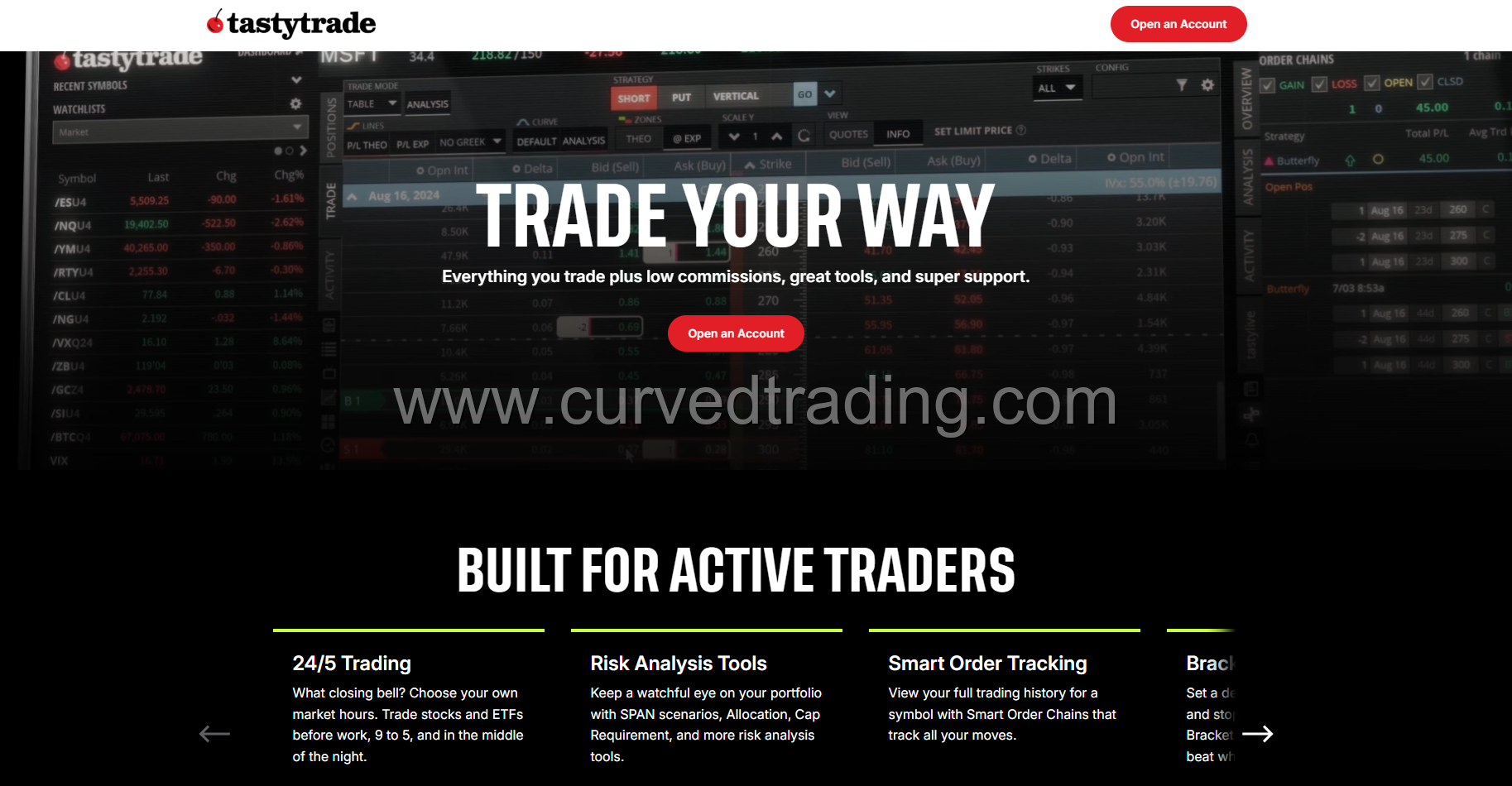
Tastytrade’s platform is available as a desktop application, web platform, and mobile app. All three are built with options trading as the organizing principle.
Desktop Platform
The core tastytrade experience. Clean, fast, and built around the metrics that options traders care about.
Key features:
- Options chain with Greeks, Delta, Gamma, Theta, Vega, and Rho displayed prominently. Sort and filter by strike, expiration, and Greek values.
- IV Rank and IV Percentile, displayed for every ticker, every day. The single most important metric for premium-selling strategies, when is IV high relative to history?
- Probability of Profit (POP), tastytrade displays the statistical probability of a trade being profitable at expiration based on options pricing. This is the core of the tastytrade trading philosophy.
- Position page, a unified view of all open positions with real-time P&L, delta exposure, and days to expiration. Built for managing a portfolio of options positions simultaneously.
- Rolling tools, roll options positions forward in time or to different strikes with a few clicks. Essential for active options management.
- Futures trading, integrated alongside equities and options in the same interface.
- Watchlists and scanners, filter by IV Rank, sector, earnings, and more.
- Paper trading, a simulated environment for practicing strategies without risking capital. Our Paper Trading Guide covers how to use this effectively.
Mobile App
One of the better mobile options trading apps in the industry. Full options chain access, position management, and order entry, not a stripped-down version of the desktop. For options traders who manage positions on the go, it’s genuinely capable.
tastytrade LIVE
Integrated financial media, live programming during market hours featuring professional traders discussing positions, strategies, and market conditions in real time. Unique in the brokerage industry. Whether you treat it as education or entertainment, it’s a differentiator no competitor offers.
Account Types
- Individual brokerage, standard taxable account
- Joint brokerage, for partners or spouses
- Traditional IRA, options trading is permitted with appropriate approval
- Roth IRA, options and futures in a tax-advantaged structure
- SEP-IRA, for self-employed individuals
- Trust, for trust-held assets
- Corporate / LLC, for trading entities
Minimum deposit: $0 to open. Margin accounts require meeting standard margin minimums. Options trading approval requires completing tastytrade’s options agreement, with different levels permitting different strategies.
Margin and Buying Power
Tastytrade offers portfolio margin for qualifying accounts, a more capital-efficient margin model that calculates margin requirements based on the net risk of an entire portfolio rather than individual positions. For sophisticated options traders running delta-neutral or hedged strategies, portfolio margin can significantly increase buying power compared to standard Reg T margin.
Standard Reg T margin is available for all margin-approved accounts.
Margin rates are competitive within the retail brokerage space, better than full-service banks, roughly in line with Schwab and Fidelity for most debit balance tiers.
Regulation and Security
Tastytrade is a registered broker-dealer and a member of FINRA and SIPC. Customer accounts are protected up to $500,000 (including $250,000 for cash) through SIPC.
The firm operates as a subsidiary of tastytrade, Inc., which is backed by institutional investors and has been operating continuously since 2017. Its regulatory record is clean, and it is subject to standard FINRA oversight.
Tastytrade vs. The Competition
Tastytrade vs. thinkorswim (Schwab)
The most natural comparison, both platforms have roots in the same founding team. thinkorswim is more powerful for technical analysis, stock trading, and deep platform customization via thinkScript. Tastytrade is more focused, more elegant for pure options workflow, and significantly cheaper for high-frequency options trading (capped commissions vs. $0.65/contract with no cap). For serious options traders who primarily sell premium, tastytrade often wins on cost and workflow. For traders who also want robust stock trading, charting depth, and retirement accounts, thinkorswim/Schwab has more to offer. Read our Charles Schwab Review.
Tastytrade vs. Interactive Brokers
Interactive Brokers offers the widest global market access, the lowest margin rates in retail, and options tools that rival tastytrade’s for professional traders. IBKR’s commission model can be cheaper for very large-contract trades but less favorable for smaller sizes. Tastytrade wins on user experience and the capped commission model for active retail options traders. IBKR wins on global access, margin rates, and institutional-grade infrastructure for sophisticated traders. Read our Interactive Brokers Review.
Tastytrade vs. E*TRADE
ETRADE’s Power ETRADE platform is a strong options tool and a natural comparison. Tastytrade’s capped commissions make it cheaper for active traders. ETRADE counters with broader investment options, stronger retirement infrastructure, and Morgan Stanley integration. For pure options trading frequency, tastytrade wins on cost. For a more complete brokerage relationship, ETRADE offers more. Read our E*TRADE Review.
Tastytrade vs. Cobra Trading
Different specialties. Cobra is the direct-access specialist for day traders and short sellers. Tastytrade is the options and futures specialist. There’s minimal overlap in target audience, choose based on your primary strategy. Read our Cobra Trading Review.
The Bottom Line
Tastytrade is the options broker built by people who trade options for a living, and it shows in every design decision, from the capped commission model to the prominence of IV Rank to the free-to-close structure.
For active options traders running premium-selling strategies, managing portfolios of positions, and trading frequently enough that commission costs matter, tastytrade offers one of the most cost-efficient and workflow-appropriate platforms available. The capped commissions, the $0 to close, the portfolio margin for qualifying accounts, and the integrated educational media create a package that no generalist broker replicates.
It’s not a complete financial platform. It doesn’t want to be. It wants to be the best broker for options traders, and it makes a strong case for that title.
TRADE Review 2026](/brokers/etrade)*
All investing involves risk. Options trading involves significant risk and is not appropriate for all investors. This article is for educational purposes only and does not constitute financial advice.