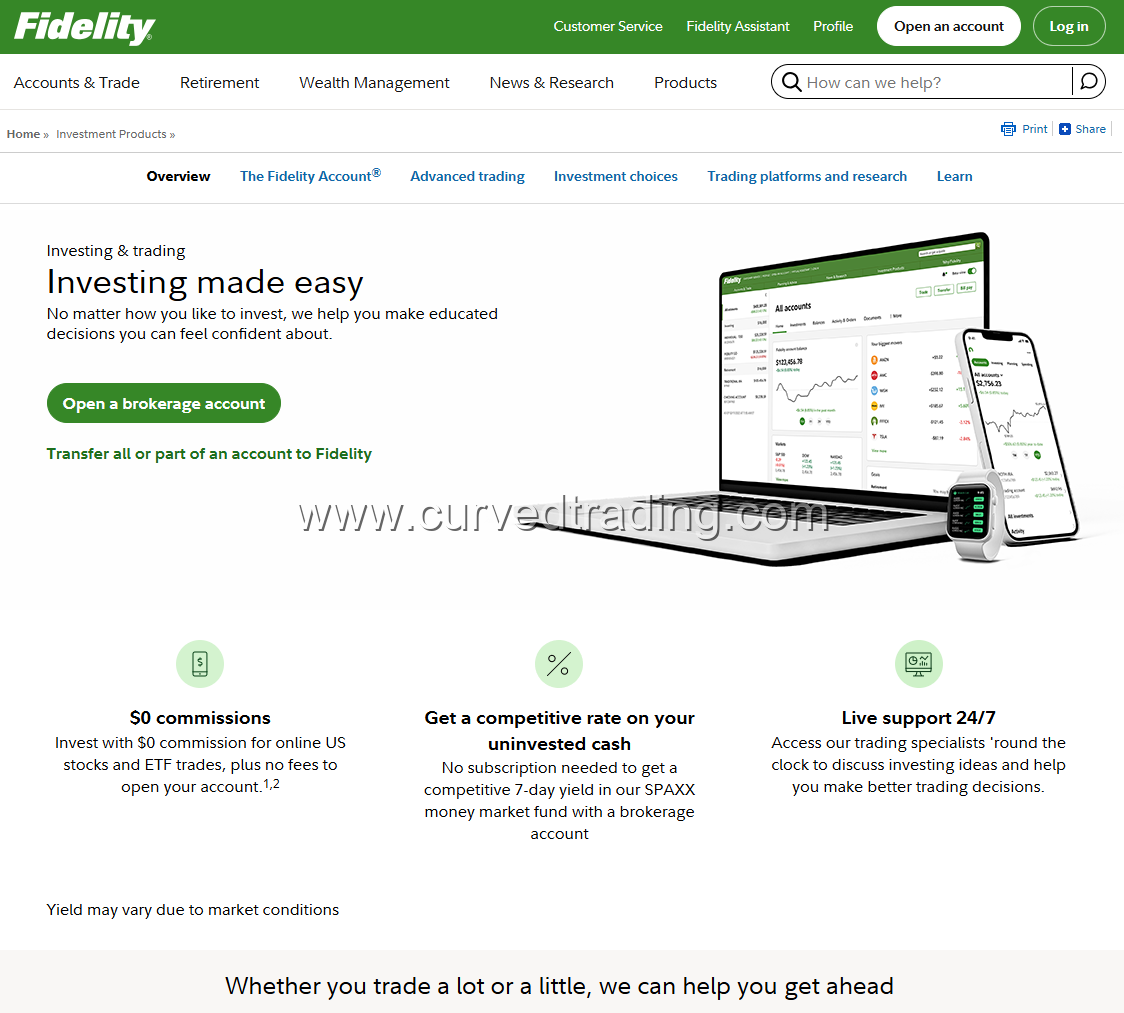
The Quiet Giant of American Investing
Fidelity Investments doesn’t make a lot of noise. It doesn’t have a celebrity spokesperson or a viral marketing campaign. It doesn’t court controversy or make bold public statements about disrupting finance.
What it does is manage over $14 trillion in assets, serve more than 43 million individual investors, and operate what many financial professionals consider the gold standard retail brokerage in the United States.
Founded in 1946 by Edward C. Johnson II and still privately owned by the Johnson family, Fidelity has spent nearly 80 years doing one thing: building long-term wealth for its clients without answering to public shareholders or quarterly earnings pressure. That private ownership structure, rare among financial institutions of its scale, means Fidelity can make decisions with a long time horizon that publicly traded competitors sometimes can’t afford.
The result is a broker that leads in retirement accounts, index fund costs, cash management, research quality, and customer service. While also offering a serious active trading platform for investors who want both.
If you’re building wealth for the long term and want the best possible infrastructure to do it, Fidelity belongs at the top of your list.
Who Is Fidelity Built For?
Fidelity’s breadth is comparable to Schwab’s, but its strengths concentrate in specific areas that make it particularly compelling for certain types of investors.
Fidelity is built for:
Retirement investors. This is Fidelity’s historical core, and it shows. IRAs of every type, 401(k) administration for employers, rollover support, Roth conversion tools, required minimum distribution calculators, the retirement infrastructure is deeper here than almost anywhere else. Millions of people have their entire retirement savings at Fidelity for a reason.
Index fund investors. Fidelity’s ZERO funds, index funds with literally zero expense ratio, are an industry-first that no competitor has matched. FZROX (total market), FZILX (international), FZIPX (extended market), and FZROX variants give passive investors market exposure at zero annual cost. For long-term investors compounding over decades, eliminating expense ratios matters significantly.
Investors who want fractional shares. Fidelity allows fractional share investing in stocks and ETFs for as little as $1. This makes building a diversified portfolio accessible regardless of account size, and lets investors put every dollar to work rather than leaving cash idle.
Investors who want strong research. Fidelity’s research platform aggregates analysis from over 20 independent providers alongside its own proprietary research team. For investors who make decisions based on fundamental analysis, the research depth here is excellent.
Active traders who still want full-service infrastructure. Active Trader Pro, Fidelity’s desktop trading platform, is a serious tool for swing traders and active investors who want professional charting and screening alongside retirement accounts and long-term holdings.
Investors who want cash management. The Fidelity Cash Management Account functions as a bank account, debit card, ATM fee reimbursement worldwide, mobile check deposit, bill pay, with your cash swept into money market funds earning competitive yields. For investors who want their idle cash working while staying liquid, this is one of the best cash management solutions in retail finance.
Fidelity is NOT ideal for:
- Dedicated day traders who need direct-access speed and deep short locate inventory, Cobra Trading and Centerpoint are built for that
- Crypto investors, Fidelity’s crypto exposure is limited compared to specialized platforms
- Traders who need the fastest possible execution on high-frequency strategies
The Platforms
Active Trader Pro, The Desktop Platform
Fidelity’s flagship desktop trading platform. Significantly more powerful than the standard web interface, built for investors who want professional-grade tools without leaving the Fidelity ecosystem.
Key features:
- Advanced charting, 60+ technical indicators, multiple chart types, drawing tools, and multi-chart layouts.
- Real-time streaming data, live quotes, news, and market data across multiple assets simultaneously.
- Options tools, full options chains with Greeks, strategy builders, and probability analysis. Not at thinkorswim’s level, but solid for intermediate options traders.
- Customizable screeners, filter stocks and ETFs by technical and fundamental criteria in real time.
- Basket trading, buy or sell multiple securities simultaneously. Useful for portfolio rebalancing.
- Level 2 quotes, market depth data for stocks, with direct routing options for active traders. See our Level 2 Market Data Guide for how to read this effectively.
Cost: Free with a Fidelity account.
Fidelity.com Web Platform
The standard browser interface, clean, well-organized, and capable for most investment tasks. Better than most broker web platforms, with solid research integration, account management, and order entry. If you don’t need the full Active Trader Pro suite, the web platform handles daily investing tasks well.
Fidelity Mobile App
One of the better mobile brokerage apps in the industry. Full trading functionality, account management, research access, and biometric login. Suitable for investors who monitor positions and place occasional trades from their phone.
Commission Structure
Fidelity charges $0 commissions on online stock and ETF trades. No minimums, no account fees.
Where Costs Exist
- Options: $0.65 per contract, standard industry rate. Fidelity does not charge a base commission per options trade, only the per-contract fee.
- Mutual funds: $0 for Fidelity funds and thousands of no-transaction-fee (NTF) funds. $49.95 for funds outside the NTF list.
- Bonds/fixed income: Treasuries free at auction; secondary market trades have a per-bond fee.
- International stocks: $0 on many international markets through Fidelity’s global trading; some markets have per-trade fees, check Fidelity’s current schedule.
- Broker-assisted trades: $32.95 surcharge.
The ZERO Funds, The Real Story
Fidelity’s zero-expense-ratio index funds are the most important cost advantage the firm offers:
- FZROX, Fidelity ZERO Total Market Index Fund: 0.00% expense ratio
- FZILX, Fidelity ZERO International Index Fund: 0.00% expense ratio
- FZIPX, Fidelity ZERO Extended Market Index Fund: 0.00% expense ratio
- FZROX (Large Cap variant): 0.00% expense ratio
For context, Vanguard’s comparable index funds, long considered the low-cost leader, charge 0.03–0.04% annually. On a $500,000 portfolio over 30 years, that difference compounds meaningfully. Fidelity’s ZERO funds are only available at Fidelity (they can’t be transferred to other brokers), but for investors building wealth inside Fidelity accounts, they’re an unambiguous advantage.
Margin Rates
Fidelity’s margin rates are tiered and competitive with Schwab and E*TRADE, better than full-service banks but higher than specialist direct-access brokers. For long-term investors using occasional margin, the rates are reasonable. For active traders carrying large leveraged positions frequently, dedicated day trading brokers offer lower rates.
Account Types
Fidelity offers one of the most comprehensive account lineups in retail brokerage:
- Individual brokerage, standard taxable account
- Joint brokerage, for spouses or partners
- Traditional IRA, pre-tax contributions, tax-deferred growth
- Roth IRA, after-tax contributions, tax-free qualified withdrawals
- Rollover IRA, for 401(k) and employer plan transfers
- SEP-IRA, for self-employed individuals and small business owners
- SIMPLE IRA, for small businesses with employees
- Inherited IRA, for beneficiaries
- Custodial (UGMA/UTMA), for minors
- 529 College Savings, tax-advantaged education savings
- Health Savings Account (HSA), triple tax-advantaged medical savings
- Trust, for trust-held assets
- Corporate / business, for entities
- Fidelity Cash Management Account, banking-equivalent with competitive yield
- Fidelity Go, robo-advisor with 0% advisory fee under $25,000
Minimum deposit: $0 for most accounts. No minimum to open, no minimum to maintain.
Regulation and Security
Fidelity is one of the most financially secure institutions in retail brokerage. As a privately held firm, it is not subject to the quarterly earnings pressure of publicly traded competitors, a structural advantage that has allowed it to invest in customer service and infrastructure consistently over decades.
Fidelity is a member of FINRA and SIPC, with SIPC coverage up to $500,000 (including $250,000 for cash). Fidelity also provides excess coverage through a third-party insurer well beyond SIPC limits, one of the most protective account security arrangements in retail finance.
The firm has been operating continuously since 1946 and has maintained a clean regulatory record throughout.
Fidelity vs. The Competition
Fidelity vs. Charles Schwab
The most debated comparison in retail investing. Both are excellent, the choice comes down to priorities. Fidelity wins on fund costs (ZERO funds), research depth, cash management yield, and HSA accounts. Schwab wins on active trading tools (thinkorswim is superior to Active Trader Pro for options and advanced charting) and integrated banking. For pure long-term wealth building, Fidelity has a slight edge. For active traders who want to keep everything in one place, Schwab’s thinkorswim gives it the advantage. Read our full Charles Schwab Review.
Fidelity vs. Vanguard
Vanguard invented index fund investing and remains the leader in low-cost passive investing philosophy. But Fidelity’s ZERO funds now undercut even Vanguard on expense ratios, while also offering a dramatically better trading platform, better cash management, and better active support. For pure passive investing in a taxable account, it’s genuinely close. For anyone who wants any active trading capability alongside index funds, Fidelity is the clear choice.
Fidelity vs. E*TRADE
ETRADE (now Morgan Stanley) is stronger for active traders and options with Power ETRADE’s interface. Fidelity counters with superior fund selection, better retirement infrastructure, ZERO funds, and the cash management account. For active traders and options, the platforms are comparable. For long-term investors and retirement savers, Fidelity wins. Read our E*TRADE Review.
Fidelity vs. Cobra Trading
Completely different tools for completely different investors. Cobra is a specialist direct-access broker for active day traders and short sellers. Fidelity is a full-service broker for wealth-builders. If you’re day trading 50+ times a day and shorting stocks, Cobra wins. If you’re building retirement savings and investing in index funds, Fidelity wins. Read our Cobra Trading Review.
The Bottom Line
Fidelity Investments is the broker for people who are serious about building wealth over the long term, and who want the best possible infrastructure to do it.
The zero-expense-ratio ZERO funds are an industry-first that no competitor has matched. The retirement account depth is best-in-class. The cash management integration is one of the most practical financial tools in retail banking. The research is deep. And the $0 minimum deposit means any investor can start, at any account size, with no friction.
Where Fidelity gives ground is in active trading speed and platform sophistication, thinkorswim at Schwab is better for serious options traders and day traders. But for the investor whose primary goal is building long-term wealth through disciplined, low-cost investing, Fidelity makes a compelling case as the best broker in the business.
Nearly 80 years. $14 trillion. 43 million investors. There’s a reason.
All investing involves risk. This article is for educational purposes only and does not constitute financial advice.