The Broker That Grew Up With the Market
Charles Schwab didn’t just survive the discount brokerage revolution, it started it.
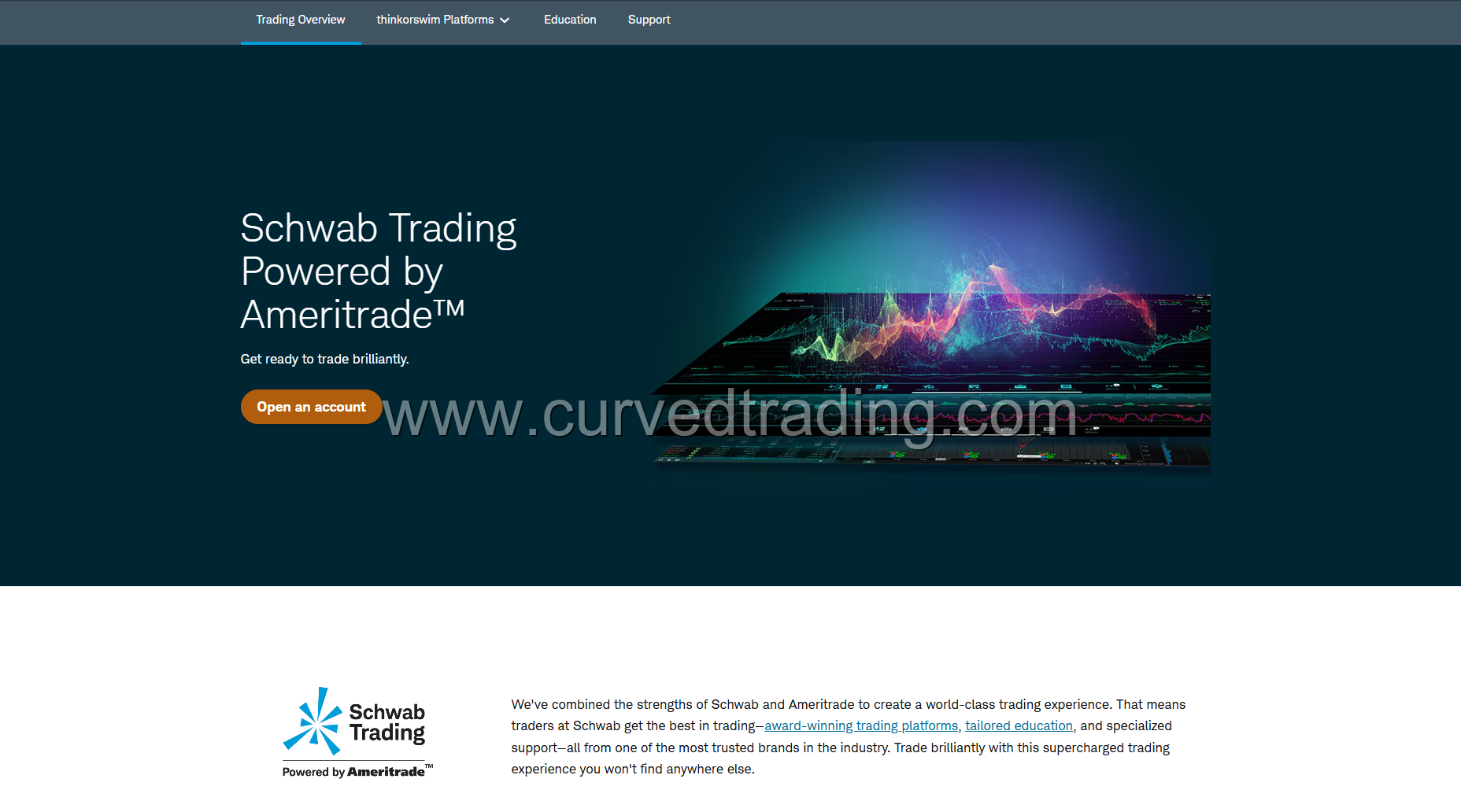
Founded in 1971 by Chuck Schwab himself, the firm pioneered the idea that everyday investors shouldn’t have to pay full-service commissions just to buy stocks. Fifty years later, Schwab completed the logical endpoint of that vision: it dropped commissions to zero entirely. And then it absorbed TD Ameritrade, one of its biggest competitors, and inherited the legendary thinkorswim trading platform along with it.
The result is one of the most comprehensive brokerages in the world. Charles Schwab today serves over 30 million accounts, offers everything from basic stock trading to managed portfolios to banking services, and operates one of the most powerful retail trading platforms ever built. It’s not the most specialized broker for any single strategy. But it’s the most complete package for the widest range of investors and traders.
If you’re building long-term wealth, trading options, managing retirement accounts, or simply want one trusted institution that handles your entire financial life, Schwab is one of the first names you should know.
Who Is Charles Schwab Built For?
Schwab’s breadth is its defining feature. It serves a wider range of investor types than almost any other broker on the market.
Schwab is built for:
Long-term investors and retirement savers. IRAs, 401(k) rollovers, Roth conversions, SEP-IRAs for the self-employed, Schwab’s retirement infrastructure is comprehensive. If you’re building wealth over decades, Schwab has the account types, the investment options, and the planning tools to support the entire journey.
Options traders. thinkorswim, the platform Schwab inherited through its acquisition of TD Ameritrade, is one of the most powerful options trading platforms available to retail traders. Full options chains, multi-leg strategy builders, probability analysis, volatility tools, and paper trading. Serious options traders rank it among the best in the business.
Passive investors who want automation. Schwab Intelligent Portfolios is the firm’s robo-advisor, automated, diversified portfolio management based on your risk tolerance. No advisory fee. No minimum beyond $5,000. For investors who want market exposure without active management, it’s a strong option.
Investors who want banking alongside brokerage. Schwab Bank is a full-service bank integrated with your brokerage. The Schwab investor checking account has no fees, no minimums, and reimburses ATM fees worldwide. For people who want one financial institution managing their money, Schwab is rare in offering this level of integration.
Swing traders and active investors. Not a day trading powerhouse, but Schwab’s tools, thinkorswim charting, screeners, technical analysis, and direct routing, are more than adequate for swing traders and active investors who aren’t executing 50 trades per day.
Schwab is NOT ideal for:
- Dedicated day traders who need sub-millisecond execution and deep short locate inventory, see Cobra Trading or Centerpoint for that
- Crypto-focused investors, Schwab has limited crypto exposure
- Traders who need the deepest hard-to-borrow short inventory, Schwab’s locate access doesn’t compete with specialist short-selling brokers
The Platforms
thinkorswim, The Crown Jewel
When Schwab acquired TD Ameritrade in 2020, it gained something it didn’t have before: thinkorswim. And thinkorswim is extraordinary.
Originally built by a team of options traders in the late 1990s, thinkorswim has been refined over 25 years into one of the most powerful retail trading platforms ever created. It’s available as a desktop application, a web platform, and a mobile app, and all three are genuinely capable.
Key features:
- Options analysis, full options chains with Greeks, probability cones, theoretical values, and multi-leg strategy builders. If you trade options, this is one of the best tools available at any price point.
- Advanced charting, hundreds of technical indicators, custom studies written in thinkScript, multi-chart layouts, and drawing tools.
- Paper trading, a full simulated trading environment with live market data. Practice strategies without risking capital. Our Paper Trading Guide covers how to get the most out of this.
- Screeners and scanners, filter stocks, ETFs, and options by virtually any criteria in real time.
- Direct routing, for active traders, order routing options give you control over execution.
- thinkScript, Schwab’s proprietary scripting language for building custom indicators and strategies. A genuine competitive advantage for technically minded traders.
Cost: Free with a Schwab account.
Schwab.com Web Platform
The standard web interface, simpler than thinkorswim, suitable for investors who want to buy, hold, and manage portfolios without the full trading suite. Clean, functional, and well-integrated with account management and banking.
Schwab Mobile
A capable mobile app for monitoring positions, placing trades, and managing accounts on the go. Not a day trading tool, but solid for the investor who checks their portfolio and places occasional trades from their phone.
Commission Structure
Schwab charges $0 commissions on online stock and ETF trades. This is the baseline that most major brokers now match.
Where Costs Exist
- Options: $0.65 per contract (industry standard). Can be negotiated lower for high-volume traders.
- Mutual funds: $0 for Schwab’s own funds and many third-party funds on the no-transaction-fee list; $74.95 for other funds traded through the platform.
- Futures: $2.25 per contract plus exchange fees.
- Fixed income / bonds: Varies by instrument, Treasuries are free at auction, secondary market trades have a per-bond fee.
- Broker-assisted trades: $25 surcharge for trades placed through a human broker.
Margin Rates
Schwab’s margin rates are higher than specialist day trading brokers like Cobra or TradeZero. Rates are tiered based on debit balance and are competitive with Fidelity and E*TRADE but significantly above what direct-access brokers charge. For long-term investors using occasional margin, it’s acceptable. For active day traders carrying large overnight positions, it’s a cost worth comparing.
Account Types
Schwab offers one of the most comprehensive account menus in retail brokerage:
- Individual brokerage, standard taxable account
- Joint brokerage, for spouses or partners
- Traditional IRA, tax-deductible contributions, tax-deferred growth
- Roth IRA, after-tax contributions, tax-free qualified withdrawals
- Rollover IRA, for 401(k) transfers
- SEP-IRA, for self-employed individuals and small business owners
- SIMPLE IRA, for small businesses with employees
- Inherited IRA, for beneficiaries
- Custodial (UGMA/UTMA), for minors
- Trust, for trust-held assets
- Corporate / business, for entities
- Schwab Intelligent Portfolios, automated robo-advisor
- Schwab Managed Portfolios, professionally managed with advisor oversight
Minimum deposit: $0 for most account types. $5,000 for Schwab Intelligent Portfolios.
Regulation and Security
Charles Schwab is one of the most heavily regulated and well-capitalized brokerages in the United States. It is a member of FINRA and SIPC, with SIPC coverage up to $500,000 (including $250,000 for cash). Schwab also carries excess SIPC coverage through Lloyd’s of London for additional protection.
The firm is publicly traded (NYSE: SCHW), publishes regular financial disclosures, and has maintained a continuous operating history since 1971. It is among the most financially secure retail brokers in existence.
Charles Schwab vs. The Competition
Schwab vs. Fidelity
The most common comparison in retail brokerage, and genuinely close. Both offer $0 commissions, excellent retirement account infrastructure, and strong research tools. Fidelity edges out Schwab on mutual fund selection (Fidelity’s own zero-expense-ratio funds are hard to beat) and fractional shares on a wider range of stocks. Schwab counters with thinkorswim, a better active trading platform than anything Fidelity offers, and the integrated banking relationship. Read our full Fidelity Review.
Schwab vs. E*TRADE
ETRADE (now part of Morgan Stanley) is a strong competitor on options tools and active trading. Schwab’s thinkorswim is generally considered superior for options analysis. ETRADE’s Power E*TRADE platform is more accessible for intermediate options traders. Both are strong, the choice often comes down to platform preference. Read our E*TRADE Review.
Schwab vs. Cobra Trading
Different markets. Cobra is a specialist direct-access broker for active day traders and short sellers. Schwab is a full-service broker for the full range of investor types. If you’re day trading 50+ times a day and need short locates, Cobra wins. If you’re building a retirement portfolio and trading options, Schwab wins. Read our Cobra Trading Review.
Schwab vs. Robinhood
Schwab is the institutional-grade, full-service brokerage with 50+ years of history. Robinhood is the consumer app that democratized trading for beginners. Schwab wins on every dimension of depth and seriousness. Robinhood wins on simplicity and mobile UX. Read our Robinhood Review.
The Bottom Line
Charles Schwab is the broker for people who want everything in one place, and done well.
The zero-commission structure, thinkorswim’s trading power, best-in-class retirement account infrastructure, integrated banking, and robo-advisory combine into a package that very few brokers can match in breadth. It’s not the sharpest tool for any single strategy, dedicated day traders will find better execution at Cobra, dedicated short sellers will find better locates at Centerpoint, and dedicated index investors will find lower fund costs at Fidelity, but for the investor who wants a single trusted home for their entire financial life, Schwab is one of the strongest answers in the market.
It’s been at this for over 50 years. It’s not going anywhere.
All investing involves risk. This article is for educational purposes only and does not constitute financial advice.