The App That Started a Revolution, And Never Stopped Building
Robinhood didn’t just enter the brokerage industry in 2013. It broke the door down.
Before Robinhood, trading commissions were a fact of life. Every broker charged $5, $7, $10 per trade, and that was the discount rate. Robinhood said zero. The entire industry laughed. Then, one by one, every major broker in America followed suit and dropped their commissions to match. Schwab. Fidelity. TD Ameritrade. All of them. Robinhood didn’t just build a product, it rewrote the economics of an entire industry.
Fast forward to 2026, and Robinhood is no longer the scrappy startup that disrupted Wall Street. It’s a publicly traded company on NASDAQ under the ticker HOOD, serving over 23.9 million funded customers with $129.6 billion in assets under custody. It has an IRA with a contribution match, a credit card with 3% cash back, prediction markets, crypto trading, futures, and a desktop platform called Legend that would have been unthinkable from this company five years ago.
The question in 2026 isn’t whether Robinhood is legitimate. It’s whether it’s the right broker for you.
Who Should Use Robinhood?
Robinhood is an excellent fit for:
Complete beginners. No other broker makes the first trade feel as simple as Robinhood. The interface is clean, intuitive, and deliberately unintimidating. If you’ve never bought a stock before, Robinhood removes every friction point between you and that first position. There’s no minimum deposit, no account maintenance fees, and the app walks you through each step.
Mobile-first investors and traders. Robinhood was built for your phone. The mobile app remains the gold standard for mobile trading, fast, responsive, and surprisingly deep. In 2026, the app includes advanced charting with technical indicators like RSI, MACD, Bollinger Bands, and moving averages, all accessible without leaving the trade screen.
Options traders who want zero contract fees. Robinhood charges no per-contract fee on standard equity options. For active options traders, this adds up fast. A trader making 50 contracts per day saves thousands annually compared to brokers charging $0.50–$0.65 per contract.
Crypto-curious investors. Robinhood supports 40+ cryptocurrencies inside the same app where you trade stocks, no separate exchange, no separate account, no separate login. For someone who wants Bitcoin and Apple in the same portfolio, the convenience is unmatched.
IRA savers who want a match. Robinhood offers a 1% IRA contribution match on the free tier and 3% for Gold subscribers. No employer required. This is a feature that no other self-directed brokerage offers at this level, and for long-term savers, the math is compelling.
Robinhood is not the right fit for:
- Active day traders who need Level 2 data and advanced order routing (Webull and Interactive Brokers are stronger here)
- Investors who want mutual funds, bonds, or CDs (Robinhood doesn’t offer them)
- Traders who need a dedicated human financial advisor
- Anyone who needs joint accounts (not available) or trust accounts
- Traders who rely heavily on paper trading, Robinhood does not offer a full paper trading simulator like Webull does
If you need deep research tools, Morningstar-level analysis, and a full-service wealth management platform, Fidelity or Schwab will serve you better. But if you want speed, simplicity, and a growing feature set at zero cost, Robinhood is hard to beat.
How Is Your Money Protected?
This is the first question to answer before depositing a dollar anywhere.
SIPC Coverage
Robinhood is a member of SIPC (Securities Investor Protection Corporation). Your securities and cash are protected up to $500,000, including a $250,000 limit for cash claims, in the event of broker failure. This is the same coverage that Fidelity, Schwab, and every other registered broker-dealer carries.
FDIC Coverage on Uninvested Cash
Through Robinhood’s cash sweep program, uninvested brokerage cash is automatically swept into a network of FDIC-insured partner banks. This provides FDIC protection on your uninvested cash, the exact coverage amount depends on how many partner banks are in the sweep network. Gold members earn 3.35% APY on this uninvested cash, making it competitive with high-yield savings accounts.
Regulatory Standing
Robinhood Financial LLC is registered with the SEC, is a member of FINRA and SIPC, and is now publicly traded on NASDAQ. The public listing adds financial transparency, Robinhood files quarterly earnings, discloses revenue sources, and is subject to the scrutiny that comes with being a public company.
The bottom line: Your money is protected at industry-standard levels. Robinhood is not a fly-by-night app. It’s a regulated, publicly traded brokerage with the same fundamental protections as legacy firms.
Robinhood Gold: Is the $5/Month Upgrade Worth It?
The free Robinhood account is solid. But Robinhood Gold at $5/month ($50/year if paid annually) is where the platform genuinely separates from competitors.
What Gold gives you:
- 3% IRA contribution match, on a $7,000 annual contribution, that’s $210 in free money, minus the $50-60 annual fee. Net positive from day one.
- 3.35% APY on uninvested cash, compared to 0.01% on the free tier. If you keep $10,000 in uninvested cash, that’s $335/year in interest versus $1.
- Lower options contract fees, $0.35 per contract instead of $0.50 for index options.
- Lower margin rates, among the lowest in the industry, undercutting most competitors by roughly half.
- Robinhood Gold Card, 3% cash back on all purchases, 5% on travel through the Robinhood portal. No annual fee beyond the Gold subscription.
- Morningstar research reports, professional-grade stock analysis included.
- Level II market data, NASDAQ Level 2 quotes for active traders. For a deeper understanding of how to read Level 2 data, check our full guide: How to Read Level 2 Market Data.
- Cortex AI, AI-powered portfolio insights and analysis tools.
- Robinhood Strategies, managed portfolio service with automated rebalancing.
For $5/month, the IRA match alone pays for the subscription. Everything else is bonus. If you have more than $2,000 in your account and plan to use Robinhood as your primary brokerage, Gold is a no-brainer.
The Trading Platform: From Simple to Serious
Robinhood’s biggest criticism for years was that it was too simple for serious trading. That narrative is dead in 2026.
Mobile App
The mobile app remains Robinhood’s flagship. In 2026, it includes advanced charting with 20+ technical indicators, multiple chart types including candlestick and Heikin Ashi, drawing tools for trendlines and support/resistance, and the ability to execute trades directly from the chart. For a mobile platform, this is competitive with Webull and ahead of most legacy broker apps.
Robinhood Legend (Desktop)
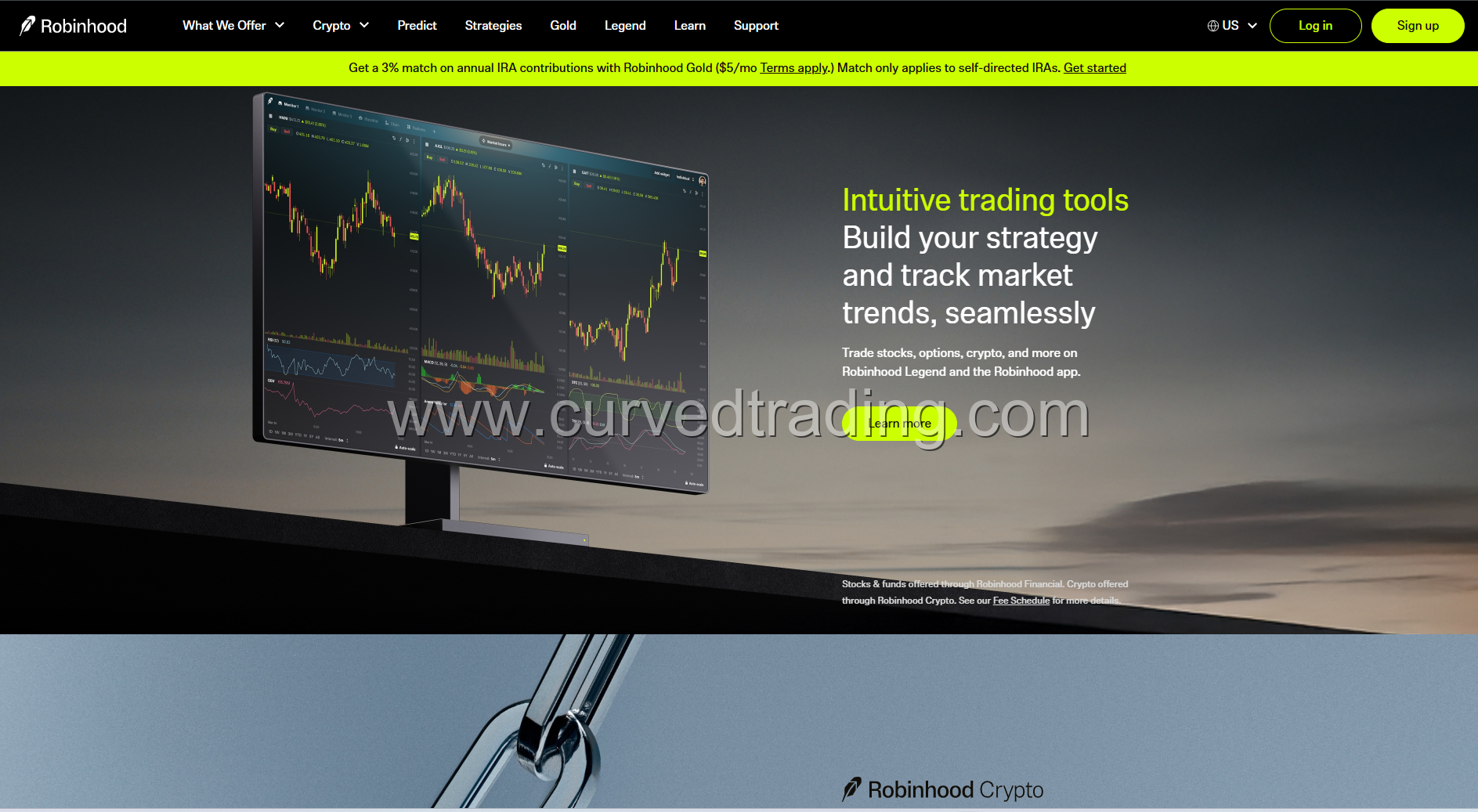
Robinhood Legend is the desktop trading platform launched to compete with thinkorswim and Webull Desktop. It includes multi-chart layouts, advanced order types, customizable watchlists, and a cleaner interface than most institutional-grade platforms. It’s still maturing, power users will find some gaps compared to Interactive Brokers’ TWS, but for 90% of active traders, Legend delivers.
What’s Still Missing
- No paper trading. This is Robinhood’s most glaring gap. Webull offers a full paper trading simulator with $1,000,000 in virtual capital. Robinhood has nothing equivalent. For new traders who want to practice before risking real money, this is a significant limitation. If paper trading is essential to your learning process, consider starting with Webull for practice and transitioning to Robinhood when you’re ready for live capital.
- Limited research depth. Morningstar reports are available with Gold, but Robinhood lacks the deep fundamental screening, economic data tools, and analyst consensus depth that Fidelity and Schwab provide.
- No backtesting. You cannot test a strategy against historical data within the platform.
What Can You Trade on Robinhood?
Robinhood’s product lineup has expanded dramatically:
- US stocks and ETFs, commission-free, fractional shares available starting at $1
- Options, no per-contract fee on standard equity options
- Cryptocurrency, 40+ coins including Bitcoin, Ethereum, Solana, Dogecoin, and more. Available 24/7.
- Futures, index, commodity, and interest rate futures now available
- Prediction markets, trade contracts on the outcomes of political events, economic indicators, sports, entertainment, and more. This is a unique offering that no traditional broker matches.
- Index options, SPX, XSP, and other index options with per-contract fees
- ADRs, access to 650+ globally listed companies through American Depositary Receipts
What you cannot trade: mutual funds, bonds, CDs, forex, and OTC penny stocks (limited access).
Fees: What Robinhood Actually Costs
The core promise holds: $0 commissions on US stocks, ETFs, and standard equity options.
Where costs exist:
- Robinhood Gold, $5/month or $50/year. Optional but highly recommended.
- Index options, per-contract fees apply (exchange fees + $0.35 for Gold, $0.50 without Gold)
- Regulatory fees, SEC and FINRA pass-through fees on sells. Fractions of a cent per share. Every broker charges these.
- Crypto, no commission on market maker routing, but optional smart exchange routing charges 0.03%–0.85% depending on 30-day volume.
- Account transfer (ACAT), $100 if you move your full account to another broker.
- Margin interest, applies to borrowed funds held overnight. Gold members get significantly lower rates.
No minimum deposit. No account maintenance fee. No inactivity fee. For the vast majority of traders, Robinhood is effectively free.
Account Types
- Individual Brokerage, standard taxable account, no minimum
- Margin Account, $2,000 minimum, enables leverage and short selling. PDT rule applies ($25,000 minimum for 4+ day trades per week).
- IRA, Traditional, Roth, and Rollover. 1% match (3% for Gold). Contributions must be held 5 years or the match is clawed back.
- Custodial Accounts, new in 2026, allowing parents to invest on behalf of minors with recurring investments
- Robinhood Strategies, managed portfolio with automated allocation
Notable gaps: no joint accounts, no trust accounts, no HSA, and no 529 plans.
Robinhood vs. Webull: Quick Comparison
Both are commission-free. Both are mobile-first. Here’s where they differ:
Choose Robinhood if: you want the IRA match, the Gold Card, crypto and prediction markets in one app, and the simplest possible interface.
Choose Webull if: you want paper trading, deeper charting out of the box, Level 2 data without a subscription, and a more trader-focused (vs. investor-focused) experience. Read our full Webull Review for the complete breakdown.
Choose both if: you want to paper trade on Webull and live trade on Robinhood. Many traders do exactly this.
The Bottom Line
Robinhood in 2026 is two products wearing the same name.
The free tier is a perfectly adequate commission-free brokerage. But so is Fidelity, Schwab, and Webull. There’s nothing wrong with it, but nothing exceptional either.
Robinhood Gold at $5/month is where the value becomes undeniable. The 3% IRA match, the 3.35% cash yield, the Gold Card with 3% cash back, the lower margin rates, and the AI-powered insights create a bundle that no competitor matches at that price point. For a new trader or investor building their first real financial hub, trading, saving, earning interest, getting cash back, Gold ties it all together in one app.
The gaps are real: no paper trading, no mutual funds, limited research depth, and customer support that still frustrates during high-volume periods. But for the core use case, commission-free trading with a growing ecosystem of financial tools, Robinhood delivers more value per dollar than it ever has.
Start with the free account. Explore the app. When you’re ready, upgrade to Gold. The math speaks for itself.
All investing involves risk. This article is for educational purposes only and does not constitute financial advice.