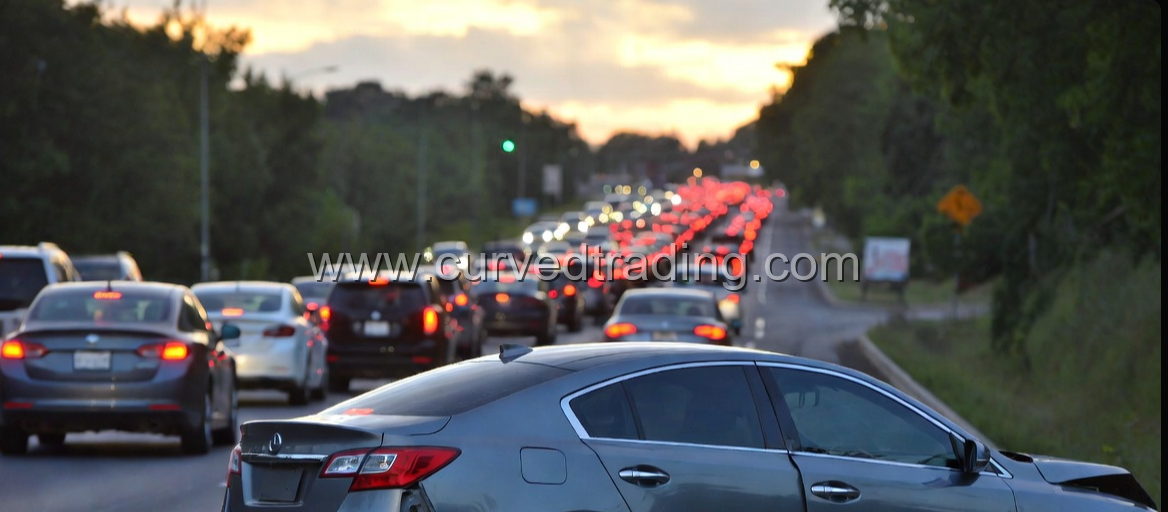
The Moment My Hands Started Sweating in a Pennsylvania Tunnel
I remember the exact tunnel. One of the long ones on the Pennsylvania Turnpike. I had been driving a semi for maybe four months. I was about halfway through the tunnel in the right lane, doing fifty-five in a sixty-five zone because I was still nervous about speed in enclosed spaces. Truck rules said I had to stay in the right lane. That was fine. I was exactly where I was supposed to be.
Then a FedEx truck with double trailers passed me on the left.
At minimum seventy miles per hour. Two trailers swinging slightly behind the cab. The tunnel was narrow enough that the air pressure changed as he went by. The sound of the engine echoed off the concrete walls. My right wheels were maybe two feet from the tunnel wall because there is no shoulder inside a tunnel. I had nowhere to go if anything went wrong. My hands were sweating so hard the steering wheel got slick.
I remember thinking, very clearly, two things. First, that driver was crazy. Second, if he swerves, I am dead. I am boxed in. Two trailers coming at me in a tunnel with no escape route.
He did not swerve. He disappeared ahead of me and the tunnel got quiet again. I drove out into daylight, pulled over at the next rest stop, and sat with my hands shaking for twenty minutes.
Four years later, in the middle of a fast market, I had the same physical reaction for the first time since trucking. A stock I was short ripped up seven percent in ninety seconds on news I had not seen. My account was bleeding in real time. My hands got slick on my mouse. My chest got tight. I was paralyzed.
That is when it clicked. I was the scared new trucker in the right lane again, and somebody far more experienced than me had just blown past me at a speed my skill level could not absorb.
This article is Part 2 of a three-part series about what commercial trucking taught me about trading. If you have not read Part 1 on why trading is a 1099 business and not a W2 job, start there. Part 3 is The Highway 99 accident and surviving your first big loss. Between the two, this is the piece about risk. About what experience actually gives you, and about why the same market move is a lethal threat to one trader and a routine opportunity for another.
Who You Are in the Tunnel Determines Everything
The most important thing about that Pennsylvania tunnel story is that there were two truckers in it, and we were in radically different situations even though we were on the same road at the same time.
I was a new driver. Four months in. Not yet comfortable with the sheer mass of the vehicle I was piloting. Nervous about speed. Nervous about tight spaces. Scanning my mirrors constantly because I had not yet built the instincts that turn scanning into an unconscious habit.
The FedEx driver was somebody else entirely. To pass a nervous new trucker in a tunnel at seventy miles an hour with two trailers, that driver had tens of thousands of hours behind the wheel. They had run that exact tunnel probably hundreds of times. They knew the exact curve of the road. They knew the exact width of the lanes. They knew how their rig handled at that speed with that load. They were not being reckless. From their seat, the pass was routine.
The danger in that moment was not the FedEx driver’s skill. It was the mismatch between their skill and mine. If I had panicked and swerved even six inches left, I would have clipped their trailer and caused a catastrophic accident. The FedEx driver’s competence could not protect them from my inexperience.
This is the exact structure of a violent market move.
Experienced traders can move through volatile tape the way that FedEx driver moves through a tunnel: fast, precise, and comfortable. They have done it thousands of times. They know what they are capable of. Inexperienced traders in that same market are in the right lane of the tunnel, white-knuckled, with no escape route.
The problem is not that the experienced trader is doing anything wrong. The problem is that both traders are in the same tunnel at the same time, and the inexperienced one does not have the skill to handle the situation they find themselves in.
Tesla Drops Seven Percent Because a Driver Crashed
Let me make this concrete with an example most of you have probably seen.
A Tesla gets in a minor accident. The driver, trying to deflect blame, claims they were using Full Self-Driving at the moment of impact. The story hits social media. Within minutes, TSLA drops six percent. Options volume explodes. Short sellers pile in. Longs panic out. The stock is in freefall for the next hour, down roughly seven percent on the day.
What happened?
On pure fundamentals, one driver crashing is not remotely material to Tesla’s earnings, cash flow, product lineup, or long-term valuation. The stock has forty million of those cars on the road. One more accident does not move the needle of intrinsic value by a cent. But that is not what determined the price that day.
What determined the price that day was the behavior of two populations in the same tunnel. Experienced traders (hedge funds, institutional quants, prop traders) saw the news, calculated that it would trigger emotional selling from retail, and front-ran that selling with short positions. Retail traders saw the news, panicked about potential regulatory or reputational damage, and sold first and thought later.
A week later, TSLA was back where it started. Sometimes higher. The move was noise. The price recovery was the market absorbing the overreaction and returning to the underlying trend.
The experienced traders who made money on that move were not clairvoyant. They were the FedEx driver in the tunnel. They knew the tunnel (meaning: they knew how retail responds to bad news), they knew their capabilities (short into panic, cover on stabilization), and they executed a move that looked insane to anyone without their experience. To them it was routine.
News events are no-trade zones for beginners for this exact reason. If you do not have the experience to be the FedEx driver, you should not be in the tunnel during a news-driven spike. You should be parked at a rest stop until the market calms down.
What Happens When I Am Now the FedEx Driver
Fast-forward a few years. I am now the one who can, technically, make the move through the tunnel.
I have watched hundreds of fast news events. I have seen the same pattern play out: initial panic, overshoot, fade back, eventual recovery. I know the stocks where the pattern is most reliable. I know the types of news where the pattern does not apply (actual bankruptcy risk, actual fraud, actual management changes) versus where it does apply (individual customer incidents, short-term PR scandals, temporary macro noise).
So when TSLA drops seven percent on a news item that is not fundamentally material, I could jump in the left lane at seventy miles an hour. I could short into the panic, cover on the stabilization, and ride the fade back. Technically I can do it.
But I often do not. And the reason is something I learned directly from being on the other side of the tunnel four months into my trucking career.
When I pass a new trucker in a tunnel at seventy, I am trusting that new trucker not to panic. I am betting that my skill plus their consistency will produce a safe outcome. Most of the time it does. Occasionally, somebody new in the right lane panics and swerves. When that happens, my skill is irrelevant. I am in an accident because of somebody else’s decisions.
Fast news events have this exact dynamic. I can technically short the panic on TSLA. But the population of retail traders in that stock is doing things I cannot control. They can create cascading liquidations I cannot predict. They can flip directions on a rumor I have not seen. They can trigger market maker responses that move the price ten percent in thirty seconds against my position.
The experienced trader’s job is not just to know their own capabilities. It is to read the other traders in the tunnel. Sometimes the right move is to take the trade. Sometimes the right move is to stay out, even though you know you could technically execute it, because the other participants in the market make the outcome unreliable.
This is why older traders are often more selective than younger ones, despite having more skill. Skill tells you what you can do. Wisdom tells you what you should actually do given who else is at the table.
The Efren Reyes article goes deeper on this idea of reading who is actually at the table before you commit to a trade. The short version: know your own skill, know the other participants, and do not take trades where your skill is insufficient to protect against what other, less skilled participants might do.
The Truckee Pass in December
Let me tell you about the night I decided not to drive.
It was December of my first winter as a commercial driver. I was coming west across the country, I-80 through Nebraska and Wyoming. Good weather most of the way. When I came into Sparks, Nevada (just east of Reno), it started snowing. Not flurries. Real snowfall, getting heavier.
I had a delivery the next morning across the Truckee Pass into California. Truckee is one of the most serious downgrades in the western United States. In December, in heavy snow, it is one of the most dangerous stretches of road in the country. And I did not have snow chains. I had never installed snow chains. I did not really know how to use them.
I pulled into a TA truck stop in Sparks around eight at night. The question was: do I push through and make the delivery on time, or do I sleep here and deal with a late delivery in the morning?
Here is the decision process I walked through, and I remember it clearly because it was the first time I had made a real life-or-death decision in the cab.
Factor one: delivery can be rescheduled. A late delivery costs money, causes friction with the broker, and may hurt my relationship with the shipper. But it is recoverable. I will still have a truck. I will still have my health.
Factor two: nighttime is more dangerous than daytime under any conditions. Visibility is worse. Fatigue is higher. Reaction times are slower. If I am going to do a difficult thing, doing it at night is strictly worse than doing it in the morning.
Factor three: I do not have the skill I would need. I have never run chains. My first time trying to install and drive with them should not be on a major downgrade in heavy snow at night. That is like learning to swim in an ocean storm.
Factor four: the specific conditions are bad. Heavy snow (not light snow), major downgrade (not flat), night (not day), no chains (not prepared).
I stacked those factors together and the answer was obvious. I slept at the truck stop.
I woke up at six in the morning to check conditions. I pulled up news searches on my phone. The top results were not chain requirement updates. They were news stories. Fox News, CNN, local Nevada outlets. Major pileup on Truckee Pass overnight. Multiple fatalities. Road closed for hours. The stories were still updating as rescue crews worked.
I had no way to know, that night in Sparks, that my decision would prove itself so dramatically within twelve hours. But the decision did not require knowing the future. The decision required a sober evaluation of the factors in play and the honest admission that I did not have what it took to do the thing I was being asked to do.
This Is Exactly How Trading Decisions Should Work
Retail traders do not make decisions this way. They make them the opposite way.
The typical retail decision process looks something like: I see a setup. I get excited. I click buy. Later, if the trade goes against me, I rationalize why I should have been more careful.
The correct process looks like the Truckee decision. Before taking a trade, you walk through the relevant factors:
- Is my thesis solid, or am I seeing what I want to see?
- Is the setup clean, or am I forcing it because I have not traded in a while?
- Am I trading during a volatile session where my skill level is insufficient?
- Do I have the tools (charts, level 2 data, news feeds) to actually execute this?
- Am I emotionally stable right now, or am I trading to recover from a prior loss?
- Is there a catalyst approaching that could produce a move I cannot predict?
- What is the actual risk-to-reward, and am I being honest about both sides?
- Is there someone far more experienced on the other side of this trade, and if so, what do they know that I do not?
Most retail traders would say yes, they think about some of this, before clicking buy. In my experience, including my own past experience, they are usually lying to themselves. They think about some of it for thirty seconds. They do not systematically evaluate.
The Truckee decision took me maybe four minutes to make. I walked through the factors in order. I was honest about the gaps in my own capability. I accepted the cost of the “safe” decision (late delivery, angry broker). And I took it.
Four minutes is not a lot of time. It is a lot more time than most traders give to their decisions. This is why paper trading matters so much before live trading. Paper trading is where you build the habit of thinking for four minutes instead of four seconds.
What Experienced Traders Forget About the Tunnel
Here is the part of the Pennsylvania tunnel story that gets harder as you move up the skill ladder.
When I was a new trucker, the tunnel scared me because I did not know what I was doing. As I became experienced, the tunnel stopped scaring me. I could drive the same stretches comfortably. I understood my rig. I knew the roads.
But an experienced trucker who has forgotten to think about the new drivers in the right lane is exactly the kind of trucker who causes accidents. The FedEx driver who passed me that day was skilled, but the trip would have ended very differently if I had panicked. Skilled truckers who pass unskilled ones in tight spaces are relying on the unskilled truckers to not do anything unexpected. Most of the time that works out. Sometimes it does not.
AMC and GameStop in early 2021 are the trading version of this.
Hedge funds like Melvin Capital had enormous short positions on GameStop. They were the experienced truckers. They knew the stock. They knew the fundamentals. They knew the fair value. Their bets were “correct” in every traditional institutional sense. GameStop at thirty dollars was arrogantly overvalued relative to its fundamentals.
What they forgot to account for was the new traders in the right lane. A population of retail traders, coordinating on Reddit, buying calls, buying shares, and locking up the float. The hedge funds were correct about fundamentals. They were wrong about the other drivers on the road.
When the short squeeze happened, it was not a matter of fundamentals. It was a matter of market structure. Retail traders panicked in a new direction (buying, not selling) in a way the hedge funds had not modeled. The hedge funds lost billions. Melvin Capital eventually closed.
This is what happens when experienced traders forget that market composition matters as much as market analysis. The FedEx driver is not just relying on their own skill. They are relying on every other driver in the tunnel to behave predictably. When a new population of drivers enters the tunnel and behaves unpredictably, even the most skilled driver is in trouble.
How to find short squeeze stocks gets into the mechanics of these setups. The deeper lesson is the one here: experience does not exempt you from considering who else is at the table.
Goldman Sachs, FedEx, and the Expendability of the Driver
There is one more parallel worth pulling out.
FedEx buys trucks and hires drivers. When a FedEx driver gets in a serious accident, what happens? The insurance pays out to the driver or their family. FedEx replaces the truck. FedEx hires another driver. The business continues.
From FedEx’s perspective, the individual driver is expendable. That is not a moral statement. It is a structural fact. Large trucking companies run fleets where human capital turns over. Some drivers stay twenty years. Many do not. The company is engineered to absorb that turnover without catastrophic loss.
Goldman Sachs, Morgan Stanley, Citadel, and every large trading firm are FedEx in this analogy. They hire new traders. Some become extraordinary. Most wash out in three to five years. The ones who wash out either break rules and get fired, underperform and get nudged out, or burn out and leave voluntarily. The firm is engineered to absorb that turnover. For every new trader who blows up a book, there are ten more ready to take the seat.
Individual traders like us are not FedEx. We are owner-operators. We own the truck. We are the driver. There is no replacement seat. If we blow up, the whole business blows up. There is no firm backing us up. There is no salary to keep paying rent.
This fact should change how you trade.
Institutional traders can take risks individual traders should never take. Not because institutional traders are smarter. Because their downside is capped (they lose their job at worst) while their upside is shared (they get bonus on gains). The expected value of aggressive risk-taking is different for them than for us.
Individual traders have unlimited downside. If you blow up your account, nobody is replacing your truck. You lose the capital you spent years building. You may also lose the next decade of compound growth that capital would have produced.
This asymmetry is why risk management is fundamentally different for retail traders than it is for institutional ones. It is also why imitating institutional risk-taking gets retail traders killed. The hedge fund manager can short a stock at thirty times their per-employee capital and go home at five. You cannot.
Slippage is your hidden enemy when you are sized into trades larger than you can survive. Stop losses exist specifically to protect against the owner-operator blow-up. Position sizing is the tire pressure and weight distribution for your personal truck.
The Three Risk Management Principles Trucking Taught Me
If I had to distill everything into three rules, they would be these.
Rule 1: Know what you actually can and cannot do. The Pennsylvania tunnel was terrifying because I did not know my rig well enough to be comfortable at those speeds in those conditions. The FedEx driver was comfortable because they did. Trading is the same. You have a skill ceiling. It is lower than you think. Trade well within it, not at its limits. Your skill ceiling rises over time, slowly, with consistent deliberate practice. Paper trading and learning the basics are how you raise it.
Rule 2: Account for the other drivers. The tunnel is not just you. There are other traders on every stock, and their skill levels and emotional states affect what your trade does. In heavy retail stocks, expect panic moves. In institutional-dominated names, expect algorithmic flow. When a major earnings event is coming, expect both. A good trade on a ghost road where nobody else is driving is not the same as the same trade on I-80 at rush hour.
Rule 3: When in doubt, stop at the truck stop. The best trade I can point to in my career was not a trade I took. It was a trade I did not take. The Truckee Pass decision. Most retail traders do not have a protocol for “I am going to not trade today.” They feel like they always should be trading. If you do not have the conditions (good setup, clear mind, liquid market, time to manage), the right trade is no trade.
The Protocol I Actually Use
When I sit down at my desk in the morning, before I open any orders:
- Evaluate my own state. Am I rested? Am I centered? Did I have a bad day yesterday that is still running in my head? If the answer is off, the trading day is off. I work on research instead.
- Evaluate the market state. Is it a trending day? A chop day? A news day? A low-volume day? Different days call for different strategies. Trying to scalp during a dull afternoon is not trading. It is boredom.
- Check the calendar. Earnings reports, Fed announcements, major data releases. If a significant catalyst is coming up today, I reduce size or sit out.
- Identify the specific setups I am looking for. If the day does not offer them, I do not force trades.
- Know my out. Before every trade, I know where I am wrong. Stop loss level is set before entry. Position size is calculated from that stop loss level. Maximum daily loss is pre-committed.
This is the Truckee decision framework applied to every trading day. It is slow. It takes discipline. It prevents most of the catastrophic mistakes new traders make.
Key Takeaways
- The same market conditions are safe for experienced traders and dangerous for new ones. A fast move in a volatile stock is routine for the FedEx driver and terrifying for the new trucker in the right lane.
- Experience is knowing what you can do. Wisdom is knowing what you should do given who else is at the table.
- Make trading decisions like life-or-death decisions. Walk through the relevant factors. Admit your capability gaps honestly. Take the safe option when the factors point that way, even if it costs you a missed opportunity.
- Institutional traders and retail traders have different risk profiles. Institutional blow-ups are covered by the firm. Retail blow-ups are covered by you. Do not imitate institutional risk-taking.
- The best trades are often the ones you do not take. A protocol for not trading is as important as a protocol for trading.
In Part 3, I talk about the accident that ended my trucking career. Highway 99, rear-ended at full highway speed, total loss of the car, internal injuries, and what that moment eventually taught me about surviving the first major loss in trading without either revenge trading your way to zero or quitting.
Disclaimer: This article is for educational purposes only and does not constitute financial advice. Trading involves substantial risk of loss, including the potential for losses greater than your initial investment. Always consult a qualified financial advisor before making trading decisions.